
Manufacturing Process Guide
CNC Machining vs. Injection Molding: How to Choose the Right Process
A practical comparison of cost, lead time, materials, tolerances, and production volume — written for engineers and buyers who already have a part, a drawing, or a STEP file and need to decide which process to quote.
Every week we receive the same question from engineers and procurement teams: should this part be machined or molded? The honest answer is that CNC machining vs injection molding is not a contest with a winner — it is a decision that depends on your part design, your material, your quantity, your timeline, and your total cost. In this guide I will walk through how both processes actually work on our floor in Shenzhen, where each one wins, where each one hurts, and how to make the call with confidence.
Machining is a decision about geometry and speed. Molding is a decision about volume and repetition. Choosing wrong is expensive in both directions.
CNC Machining and Injection Molding at a Glance
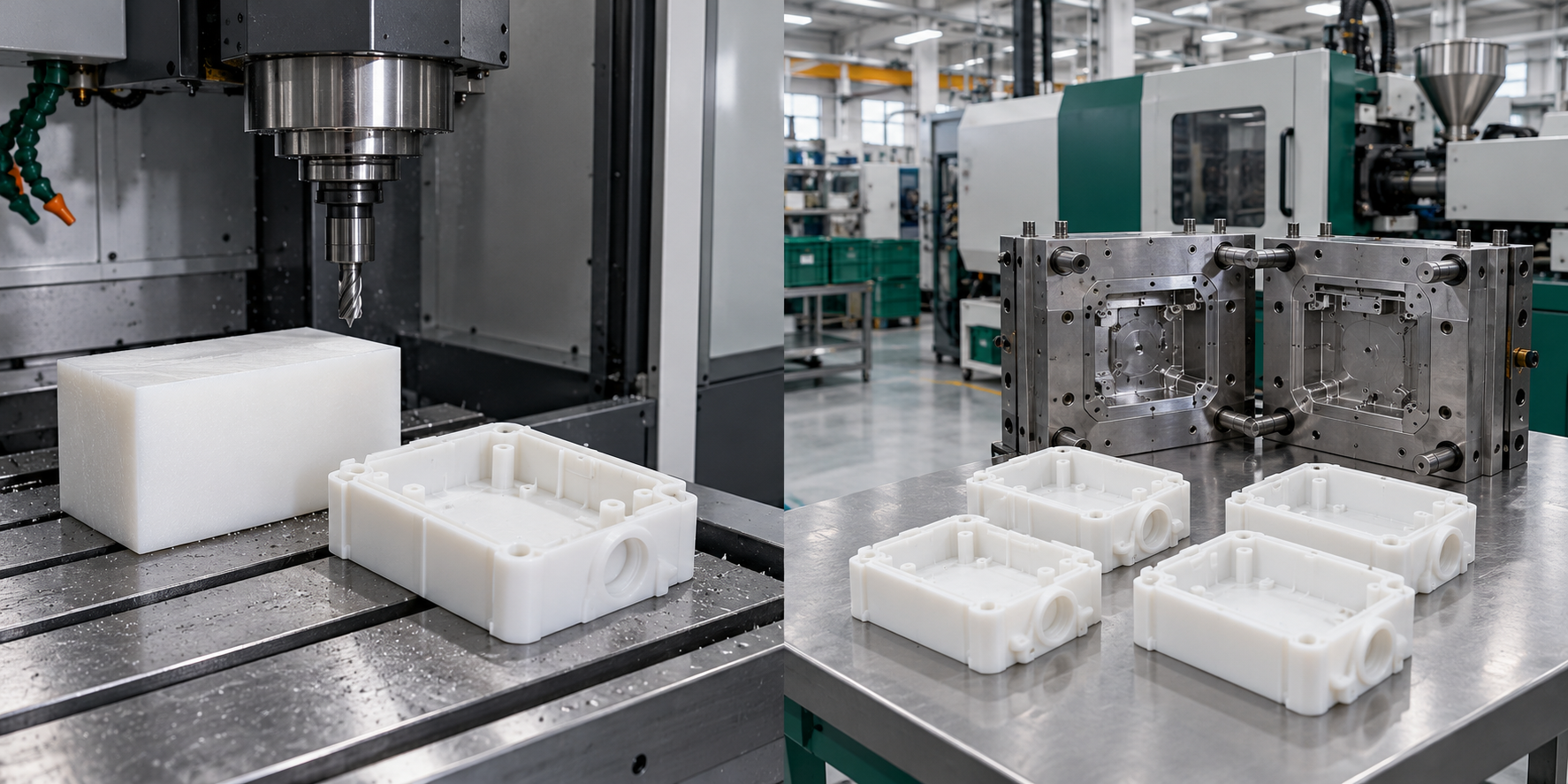
The core difference is subtractive versus formative manufacturing. CNC machining removes material from stock, while injection molding fills a dedicated cavity with molten polymer. That difference affects tooling investment, design freedom, change cost, material form, surface evidence, and the economics of repeat production.
Quantity matters, but it should not decide the process by itself. A useful comparison starts with design maturity and functional requirements, then calculates total project cost at the forecast volume.
| Decision factor | CNC machining | Injection molding |
|---|---|---|
| Dedicated tooling | No production mold; programming and fixtures may be required | Custom mold, trials, and approval are required |
| Best design stage | Evolving designs, prototypes, replacement parts, and controlled low-volume runs | Stable designs with repeat demand |
| Geometry constraint | Tool access, cutter radius, fixturing, and wall stability | Draft, wall uniformity, flow, parting, gates, ejection, and undercuts |
| Change after approval | Usually a program or fixture revision | May require steel modification, re-trial, or a replacement tool |
| Material form | Machinable sheet, plate, rod, or block | Moldable thermoplastic or compatible elastomer grade |
| Economic signal | Lower fixed investment; machine time remains in every part | Higher fixed investment; repeat volume can reduce effective cost per part |
How CNC Machining Works
CNC machining is a digital-to-physical process. We start from your CAD file or engineering drawing, define the toolpath in CAM software, and cut the part from a stock block, plate, or rod. There is no cavity and no mold — the geometry lives in the program, so a design change is a programming change, not a tooling change.
-
1
Digital design review
We review the STEP, STP, IGES, X_T, STL, DXF, DWG, or PDF you send, confirm tolerances and critical features, and flag any geometry that will be difficult to reach with a cutting tool.
-
2
Toolpath and setup
The CAM program defines tool selection, step-over, feed and speed, and workholding. Fixturing matters as much as the machine — a stable setup protects your tolerances.
-
3
Cutting and inspection
Milling and turning remove material to final form. We inspect critical dimensions before the part moves to finishing, bonding, or assembly.
Common methods include milling for prismatic and contoured shapes and turning for cylindrical parts. Typical materials span metals and engineering plastics — including POM, PA, PC, PEEK, PSU, PPSU, PPS, PBT, ABS, PP, PE, HDPE, PVC, PMMA, and PET when the application calls for them.
Because there is no mold, CNC machining is usually the right answer for prototypes, custom parts, and low-to-medium production runs — especially when the design is still moving or the material needs to be a solid, high-performance stock grade.
Why it matters
With no mold to cut, you can revise a machined part between runs and re-quote without tooling penalties. That flexibility is worth more than a few cents of unit cost during product development.
How Injection Molding Works
Injection molding is a repetition process. Once the mold exists, the same cavity produces the same part, cycle after cycle, with very little variation. The work shifts from cutting geometry to building and validating the tool that creates it.
-
1
Mold design and fabrication
We design the mold around the part — gates, runners, cooling, ejection, parting line, and draft — then machine and assemble it.
-
2
Melt and inject
Plastic pellets are melted and injected into the cavity under pressure. Cycle time, temperature, and pressure all shape the final part.
-
3
Cool, eject, and finish
The part cools in the mold, is ejected, and then moves to trimming, painting, printing, engraving, bonding, assembly, or packaging.
Common molding materials are thermoplastics and selected elastomers. In our shop that often means ABS, PP, PE, HDPE, PVC, PC, PMMA, PET, POM, PA, PBT, PPS, PEEK, PSU, and PPSU — chosen against the part's strength, temperature, chemical, and cosmetic requirements.
Injection molding is suited to repeatable, high-volume production once tooling is ready. That is the trade: you pay for the mold up front, and the process pays you back through low unit cost and consistent output.
Advantages and Limitations of Each Process
Both processes have real strengths and real constraints. Understanding them up front is what keeps a project from stalling at the tooling or production stage.
Where CNC Machining Excels
Machining wins on flexibility and material reach. You can change a design between runs with no mold penalty, order a single piece, and cut from a wide range of stock metals and engineering plastics.
-
Fast design changes. Revise the CAD, regenerate the toolpath, and cut a new version — no tooling rework.
-
No production mold. Ideal when quantities are uncertain or the design is still under test.
-
Broad material availability. Metals and engineering plastics, including grades that are not practical to mold.
-
Precise features. Tight tolerances on critical dimensions, bores, and mating surfaces when specified correctly.
-
Solid, strong parts. A good fit for functional prototypes, fixtures, and load-bearing components.
CNC Machining Trade-Offs
The same subtractive nature that makes machining flexible also makes it inefficient at scale. Machine time dominates cost, and geometry that a cutting tool cannot reach becomes expensive or impossible.
-
Per-part cost rises with quantity. Every part is cut individually, so unit cost does not drop the way it does with molding.
-
Material waste. Removed material becomes chips and scrap unless it can be recovered.
-
Tool access limits. Deep cavities, sharp internal corners, and undercuts require special tooling or additional setups.
-
Thin walls and intricate internals. These can be difficult or costly to machine and may need a DFM review before quoting.
Where Injection Molding Excels
Molding wins on repetition. Once the tool is validated, unit cost drops sharply and output becomes highly consistent — which is exactly what a production program needs.
-
Low unit cost at scale. Cycle time, not machine time, drives cost — so high volumes become economical.
-
Repeatability. The cavity defines the part, so parts stay consistent across a long production run.
-
Efficient cycle times. Short cycles make high-volume output practical.
-
Complex plastic forms. Ribs, bosses, snaps, and integrated details can be molded in when the design is built for it.
Injection Molding Trade-Offs
The mold is the whole story. It costs money and time up front, and it locks in design decisions that are expensive to reverse after fabrication.
-
Upfront cost and lead time. Mold design, fabrication, testing, and revisions all happen before the first production part.
-
Design constraints. Draft angles, uniform wall thickness, and parting line placement all shape the design.
-
Potential defects. Shrinkage, warpage, short shots, and sink marks need to be managed through tooling and process control.
Engineering note
Before committing to tooling, we review the design for manufacturability — wall thickness, draft, gate location, and undercuts. A DFM review is far cheaper than a mold revision.
CNC Machining vs. Injection Molding: Key Decision Factors
These are the six factors that decide the choice in practice. Read them in order — quantity and lead time usually narrow the field before materials and tolerances do.
Cost and Production Volume
Compare total project cost rather than unit price alone. Machining carries programming, setup, fixture, material, and machine-time costs but avoids a production mold. Molding adds mold design, fabrication, trials, and approval before production, then spreads that fixed investment over accepted parts.
| Program condition | Process signal | What to verify before deciding |
|---|---|---|
| One-off or early prototype | Machining is usually easier to justify | Stock material availability, tool access, and whether the machined part represents molded behavior |
| Pilot quantity with likely revisions | Machining or a bridge strategy may reduce change risk | Expected revisions, functional test plan, and cost of modifying a tool |
| Stable design with repeat orders | Calculate the molding break-even point | Tooling scope, cavity count, cycle assumptions, annual demand, scrap, finishing, and maintenance |
| High repeat volume | Molding often has the stronger unit economics | Mold life, capacity, quality plan, supply continuity, and design-change exposure |
There is no universal quantity at which molding wins. Use actual quotations at the first order, annual demand, and likely lifetime volume. For the underlying calculation, see the full tooling and part-cost breakdown.
Lead Time and Production Readiness
Machining can begin after programming, material confirmation, fixture planning, and drawing review. Molding must also pass mold design, fabrication, assembly, trials, dimensional review, and sample approval. The difference is structural, but it should not be converted into a fixed promise of days or weeks without reviewing the project.
Ask suppliers to separate the schedule into drawing review, material procurement, tooling or programming, first article, correction loop, production, finishing, inspection, and shipping. A moving design usually favors the route with the lower cost of change, even when another process has a faster cycle after approval.
Materials and Part Performance
Machining draws from a wider material pool because it cuts stock rather than melting it. That includes metals and engineering plastics such as POM, PA, PC, PEEK, PSU, PPSU, and PPS. Molding is limited to thermoplastics and selected elastomers that can be melted and injected reliably.
Performance depends on both the material and the process. Strength, stiffness, temperature resistance, chemical exposure, and wear requirements all narrow the choice — and so does the manufacturing method, because molded parts carry orientation and shrinkage effects that machined parts do not.
Tolerances, Precision, and Quality
Neither process is universally more accurate. Achievable tolerance depends on part geometry, material behavior, tooling condition, and how the part is inspected. Machining holds tight tolerances on accessible features; molding holds them across a cavity once shrinkage and warpage are controlled.
Specify critical dimensions explicitly rather than applying a blanket tolerance to the whole drawing. That keeps inspection focused and avoids paying for precision on features that do not need it.
Design Complexity and Geometry
Machining is constrained by tool access: internal corners carry the radius of the cutter, and deep cavities need long tools that deflect. Molding is constrained by flow and ejection: draft, uniform walls, undercuts, gates, and parting lines all shape what is possible.
Review the design for manufacturability before committing to tooling or production. A DFM review on a STEP file is the cheapest engineering hour you will spend on a project.
Waste, Energy, and Sustainability
Machining generates chips and scrap, though metal scrap is routinely recycled. Molding uses material efficiently in the cavity but consumes energy melting and cycling, and generates runners and sprue that must be handled. Regrind policies and recycled feedstock options matter on both sides.
Evaluate environmental impact across the product lifecycle rather than by process alone. Part durability, service life, and whether the part can be repaired or recycled often outweigh the difference in manufacturing scrap.
Choosing the Right Process for Your Project
Use CNC machining when the design is still changing, quantity is uncertain, stock-form material is required, or accessible critical features need direct machining. Use injection molding when the design is stable, the geometry can be molded and ejected, the resin is available as a suitable molding grade, and repeat demand can justify dedicated tooling.
Information needed for both quotations
- 3D model and a 2D drawing for critical dimensions
- Material grade or functional performance requirements
- First-order, annual, and expected lifetime quantity
- Cosmetic surfaces, color, texture, and unacceptable marks
- Inspection method, documents, packaging, and delivery location
Questions that expose the real trade-off
- How likely is a dimensional or feature change after first article?
- Which dimensions are functionally critical rather than generally tight?
- Can the part accept draft, parting lines, gates, and ejector evidence?
- Can cutters reach every machined feature without unstable tooling?
- Who owns and maintains the mold, and what happens when demand changes?
Do not force an early binary choice. A common program starts with machined parts for functional validation and moves to molding only after geometry, acceptance criteria, and demand are stable.
Can CNC Machining and Injection Molding Be Used Together?
Yes. Machined parts can validate fit, function, assembly, and selected material behavior before a production mold is approved. The molded version can then be optimized for wall thickness, draft, flow, cooling, ejection, and repeat production. The prototype should be treated as a learning tool, not proof that a geometry is ready to mold unchanged.
The two processes may also remain in the same assembly: molded housings can use machined bushings, inserts, wear components, or low-volume variants. Plasticpartsmfg supports both routes through one project review and quotation workflow, allowing the transition decision to be based on the drawing, acceptance criteria, and real volume assumptions.
Frequently Asked Questions
Is injection molding always cheaper than CNC machining?
No. Molding can achieve lower unit cost after enough accepted parts are produced, but the tool, trials, maintenance, and change risk must first be recovered. At low or uncertain quantities, machining may have the lower total project cost.
Which process holds tighter tolerances?
Neither process is universally more accurate. Machining can control accessible local features directly, while molding must account for shrinkage, flow orientation, cooling, warpage, cavity condition, and measurement timing. State the critical dimensions and inspection method instead of applying one tight tolerance to the entire part.
Can a machined prototype be used as the final mold design?
Not automatically. A machined part may lack draft, uniform walls, suitable radii, gate space, ejection surfaces, and shrinkage compensation. Use the prototype to validate the product, then complete a molding DFM review before tool release.
What if annual demand is uncertain?
Quote the first order, expected annual demand, and a realistic high case. Compare machining, bridge tooling, and production tooling against those scenarios, including the cost of likely design changes. This prevents an optimistic forecast from forcing an expensive tool too early.
What files should I submit for a process recommendation?
Provide a 3D CAD model, a 2D drawing with critical dimensions, material and performance requirements, quantity scenarios, appearance expectations, inspection needs, packaging, and target delivery location. Explain which requirements are fixed and which may change after testing.
Start Your Project
Send Your CAD Files for a Process Recommendation and Quote
Based in Shenzhen, China, Plasticpartsmfg supports custom plastic parts from a single prototype to low-volume and contract production. We accept STEP, STP, IGES, X_T, STL, DXF, DWG, and PDF files, and we can quote CNC machining and injection molding side by side so you can compare total cost at your real quantity. Materials include ABS, PP, PE, HDPE, PVC, PC, PMMA, PET, POM, PA, PBT, PPS, PEEK, PSU, and PPSU, with secondary operations such as polishing, painting, printing, engraving, bonding, assembly, and packaging.
Send your drawings or part requirements and tell us your quantity, material, tolerances, and target date. Our team will review the design for manufacturability and come back with a process recommendation and quotation.