
Custom manufacturing for OEMs
Custom Rotomolded Plastic Tanks for OEM Applications
Plasticpartsmfg manufactures custom plastic components in Shenzhen, China, including rotomolded tanks for industrial equipment, water treatment, agriculture, and vehicle applications.
Share CAD files, drawings, or a sample to discuss capacity, material, wall design, openings, mounting features, and production quantity. Prototype, low-volume, repeat production, and contract manufacturing projects are considered.
Feasibility, tooling, and production approach depend on the part geometry, resin, and order quantity.
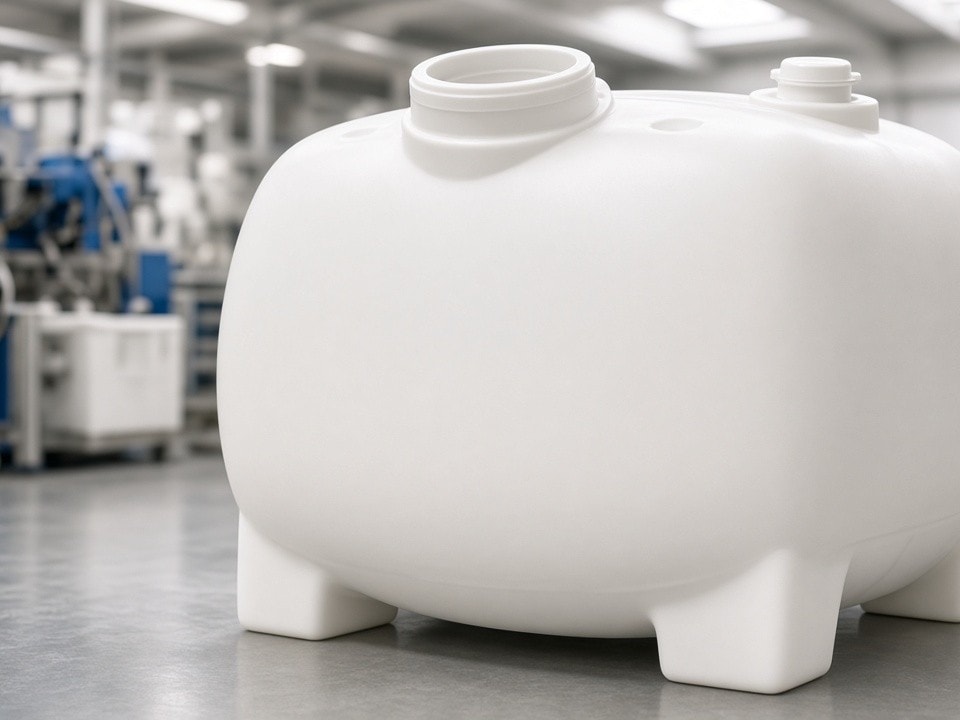
Tank geometry, interfaces, and production planning are reviewed against the intended application.
Application and geometry options
Rotomolded tank categories
These categories describe application and geometry options, not standard off-the-shelf products. Each project is reviewed against operating conditions, installation space, fluid, and interface requirements.
Rotomolded Water Tanks
For equipment and industrial systems.
Rotomolded Chemical Tanks
Subject to resin compatibility review.
Rotomolded Equipment Tanks
Designed around equipment requirements.
Rotomolded Vehicle Tanks
For vehicle and mobile equipment applications.
Rotomolded Process Tanks
For process and fluid-handling systems.
Rotomolded Custom Reservoirs
Configured for a specific OEM assembly.
Rotomolded Rectangular Tanks
Geometry developed for the installation envelope.
Rotomolded Low-Profile Tanks
Low-profile configurations for space constraints.
Rotomolded Integrated Tanks
Project-specific features and integrated geometry.
Custom Industrial Rotomolded Tanks
Custom tanks for industrial OEM requirements.
Process overview
How rotational molding works
Rotational molding forms a hollow plastic part inside a heated mold. Resin is placed in the mold, which rotates through heating and cooling stages so material distributes across the internal surfaces. The process suits many hollow parts, including tanks with complex shapes and large, continuous bodies.
Tank design must account for more than nominal capacity. Wall design, corners, ribs, openings, mounting surfaces, and manufacturing access all affect the mold and finished part. Rotomolding does not use the same high-pressure filling method as injection molding, but it still requires dedicated tooling. Tooling investment and unit economics should be evaluated against the design and expected quantity.
Part geometry
Shape, corners, ribs, and openings influence mold design and manufacturability.
Material and service
Resin selection depends on fluid, temperature, exposure, and performance needs.
Quantity and tooling
Part size, complexity, mold construction, and demand shape the production plan.
Custom tank manufacturing
Design the tank around its installation and use
A CAD model or dimensioned drawing helps the manufacturing team review capacity, mounting, wall design, materials, and large-part feasibility before design or tooling is finalized.
01 / Form and fit
Capacity, shape, and installation features
Tank capacity and outer dimensions are developed around the available installation envelope and functional requirements.
- Overall length, width, height, and usable volume
- Mounting faces, support points, and clearance
- Rectangular, low-profile, or other non-standard geometry
- Reinforcing ribs and local structural features
- Openings, ports, access points, and fitting locations
Large-part feasibility depends on the required mold and manufacturing envelope. Provide full part dimensions early.
02 / Structure
Wall design and reinforcement
Wall thickness should be set according to geometry, material, service conditions, and expected loads. Large flat areas, corners, ribs, and transitions may need particular attention to support the intended function and reduce unwanted distortion.
Share target wall thickness, load conditions, mounting method, and any available sample. Review the final design for manufacturability rather than relying on nominal thickness alone. Include defined inspection points and dimensional requirements with the drawing package.
03 / Material selection
Materials and chemical compatibility
PE and HDPE are common starting points for rotomolded tank discussions. Selection depends on stored fluid, temperature, exposure, impact requirements, color, and service environment. A resin suitable for water service may not be appropriate for a particular chemical.
Provide the fluid or compatibility requirements, operating temperature, and expected exposure. Resin suitability must be reviewed for the specific application; do not assume compatibility based on resin family alone.
04 / Interfaces
Ports, mounting, and secondary work
Identify port locations, opening sizes, mounting points, sealing surfaces, and required hardware. Molded-in features, post-formed openings, fittings, and other interface details need design and process review.
Secondary operations across plastic manufacturing services include bonding, assembly, polishing, printing, engraving, and packaging. Available operations for a specific tank depend on its material and design; list required fittings and assembly steps in the RFQ.
Tooling and production
Plan for the design and the order quantity
Rotomolding requires a mold designed for the tank geometry. A reliable tooling estimate requires a drawing or CAD model.
Tooling cost and lead time vary with part size, complexity, mold construction, and project requirements. Tooling is an important consideration when comparing rotomolding with other processes, particularly for early prototypes or limited quantities.
Plasticpartsmfg supports prototype, low-volume, bridge production, and contract manufacturing projects. Quantity affects tooling economics and the production plan, so include both the initial order quantity and anticipated repeat demand when requesting a quote.
Prototype
Evaluate the current design and manufacturing approach.
Low-volume and bridge
Review quantity alongside tooling and project requirements.
Repeat production
Include forecast demand to inform production planning.
Process selection
Is rotomolding right for your tank?
Rotomolding is worth evaluating for a hollow tank with a custom shape, integrated geometry, or a size and configuration that does not suit a standard catalog part. It may also fit a dedicated tank design for a machine, vehicle, or process system.
The best route depends on dimensions, geometry, material, quantity, and performance criteria. If the design is still in development, share the current model and intended production volume before committing to tooling.
Blow molding
May be considered for certain hollow parts and production volumes, depending on geometry and tooling.
Injection molding
Generally evaluated for smaller, more detailed parts or high-volume components when the tooling approach fits the business case.
CNC machining or 3D printing
Can support prototypes and design checks, but may not be economical for a large production tank.
Thermoforming
May suit some shell-like parts, depending on the required structure and assembly design.
OEM applications
Industrial and equipment tank applications
Custom rotomolded tanks can be developed for industrial equipment, water treatment, agriculture, vehicles, and other OEM assemblies. Include relevant conditions in your inquiry for chemical, thermal, or load-bearing applications.
Water treatment and process equipment
Agricultural machinery and equipment
Industrial equipment and fluid-handling systems
Vehicle and mobile equipment applications
Laboratory and test equipment
Custom OEM assemblies and replacement components
Prepare your inquiry
Information to include in your RFQ
Share the information available so the team can review manufacturability, material needs, and quotation requirements.
- 01. STEP, STP, IGES, X_T, or other available CAD files
- 02. Engineering drawings in PDF, DXF, or DWG format, if available
- 03. Required capacity and overall dimensions
- 04. Material preference and stored-fluid information
- 05. Wall-thickness target or structural requirements
- 06. Port, fitting, mounting, and assembly details
- 07. Color, finish, and inspection requirements
- 08. Prototype, initial production, and forecast quantities
- 09. Delivery destination and packaging requirements
Have a physical sample instead of CAD? Include photographs, key measurements, and notes about how the tank is used.
Start with your requirements
Request a rotomolded tank quote
Send drawings or CAD files to discuss your custom tank. Include the application, material requirements, target quantity, and critical dimensions or interfaces. The team can review process suitability, tooling considerations, and the details needed for a quotation.
Contact the manufacturing team
Discuss your tank requirements
Plasticpartsmfg is based in Shenzhen, China. Share your drawings or CAD files alongside application details, material requirements, target quantity, and any critical dimensions or interfaces.
Email: info@plasticpartsmfg.com
Address: Building 1, No. 8, Chenggong Industrial Park, Kukeng, Longhua District, Shenzhen