
Plastic Overmolding Services
Plasticpartsmfg manufactures custom overmolded plastic components by combining rigid substrates with soft-touch or functional secondary elastomers. Based in Shenzhen, we support product development teams and procurement managers through every phase, from DFM and rapid prototype sampling to bridge tooling and high-volume manufacturing.
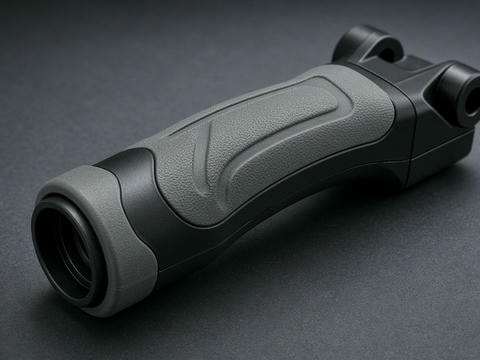
Substrate + Elastomer Bond
Chemical & Mechanical Adhesion
Manufacturing Capabilities & Specifications
We utilize professional-grade injection molding machinery to guarantee reliable chemical bonding, precise parting lines, and dependable structural durability.
| Capability Parameter | Typical Production Range |
|---|---|
| Process Technologies | Two-Shot Injection Molding (2K) & Insert Overmolding |
| Rigid Substrates | ABS, Polycarbonate (PC), PP, Polyamide (PA6/PA66), PBT |
| Overmold Materials | TPE, TPU, TPV, and compatible engineered elastomers |
| Elastomer Hardness | Shore A 30 to Shore A 90 |
| Machine Tonnage | 50 to 450 Tons clamping force |
| Typical Tolerance | ±0.10 mm to ±0.25 mm |
| Secondary Services | Pad printing, silk screening, sub-assembly, custom packaging |
Tooling & Substrate Adhesion
Bond failure and delamination are the primary failure points in multi-material molding. Our engineers optimize mechanical interlocks (undercuts, through-holes) alongside melt-temperature profiles to achieve cohesive molecular adhesion between substrate and overmold.
Uniform wall thickness (recommended 1.5–3.0 mm for substrate, 0.8–2.0 mm for elastomer) is critical to prevent sink marks and maintain balanced thermal contraction across resin types.
Engineering Benefits of Overmolding
Integrating multiple physical properties into a consolidated component eliminates mechanical fasteners and delivers tangible product advantages.
Ergonomics
Create tactile soft-touch grips, contoured handles, and responsive button interfaces that improve user comfort and non-slip control.
Protection
Integrate shock-absorbing outer bumpers and damping layers to shield internal electronic components from drops, impacts, and vibration.
Sealing
Mold watertight and airtight gasket seals directly onto enclosure perimeters, eliminating manual O-ring placement and preventing fluid ingress.
Functionality
Combine high-strength structural ribs with pliable hinges or cable strain reliefs, reducing total component count and lowering downstream assembly cost.
Material Selection & Chemical Compatibility
The durability of an overmolded part relies directly on molecular compatibility between the rigid base plastic and the elastomeric second shot. When thermal compatibility is limited, our mold engineers integrate interlock grooves, dovetails, and through-holes into the core tool design.
Click through common material combinations to review compatibility ratings and mechanical rationale:
PC/ABS Substrate with TPU Overmold
Provides exceptional impact resistance, rigid structural walls, and superior scratch protection. TPU provides an abrasion-resistant, elastomeric skin ideal for protective bumpers, button keypads, and industrial handheld devices.
- High mechanical tear strength and grease resistance
- Recommended overmold wall: 1.0–2.5 mm
- Seamless color-matching between base and elastomer
Industry Applications
From sensitive medical diagnostics to demanding automotive and consumer hardware, our multi-material components meet stringent functional criteria.
Consumer Products
Heavy-duty hand tool grips, sports equipment handles, kitchenware soft-touch accents, and ergonomic personal care hardware.
Non-slip • Aesthetic stylingElectronics & IoT
Protective enclosures for handheld barcode scanners, push-button keypads, moisture gaskets, and anti-vibration mounts.
IP sealing • Drop protectionMedical Devices
Surgical instrument grips, soft-touch diagnostic equipment covers, fluid-resistant seals, and tactile patient interface housings.
Biocompatible TPE • Chemical wipe downAutomotive Interior
Cockpit control knobs, internal wire harness grommets, HVAC dampeners, and NVH reduction components.
Low VOC • Temperature resistanceOur Production Workflow & Quality Control
We manage every phase with disciplined engineering controls to safeguard tight dimensional tolerances and consistent interfacial bonding.
DFM Review
Comprehensive review of substrate draft angles, shut-off surface designs, wall transitions, gate locations, and flow front matching.
Mold Development
In-house CNC machining, EDM, and polishing of precision two-stage or insert overmolding steel tooling built for longevity.
T1 First Article Sampling
First-article inspection (FAI) report with CMM dimensional verification, peel testing, and cosmetic review submitted for customer sign-off.
Volume Production
Stable repetitive manufacturing governed by validated cycle parameters, automated part extraction, and in-line visual inspection.
Strict Quality Control & Adhesion Assurance
Plasticpartsmfg monitors every production batch to verify bond integrity and prevent delamination under thermal cycling and mechanical stress. Our metrology room uses optical vision systems and coordinate measuring machines (CMM) to inspect dimensions down to ±0.10–0.25 mm.
Integrated Secondary Services
Consolidate your supply chain with our turnkey post-molding finishing and assembly capabilities.
Precision pad printing and silk screening for corporate branding, button iconography, scale markings, and regulatory labels.
Ultrasonic welding, heat-stake threaded inserts, fastener installation, and multi-part sub-assembly under single-source accountability.
Anti-static packaging, thermoformed blister trays, barcode labeling, and bulk or end-user retail-ready packaging solutions.
Request a Custom Quotation
Plasticpartsmfg is ready to support your next multi-material molding project. Send us your CAD files (3D formats: STEP, IGS, or X_T) along with 2D technical drawings for a comprehensive manufacturability analysis and quotation.
- CAD files in 3D STEP, IGS, or X_T format
- Base resin and overmold elastomer specifications
- Estimated annual production volumes (EAV)
- Critical cosmetic surfaces and shut-off tolerances