
Custom PC Parts & Polycarbonate Manufacturing Solutions
Plasticpartsmfg provides precision polycarbonate (PC) fabrication services for engineering prototypes, functional testing, and low-to-medium-volume production. Leveraging high impact resistance, optical clarity, and thermal stability up to 125°C, we machine, mold, and form custom PC components matching your exact 2D/3D technical drawings and tolerance requirements.
Polycarbonate Engineering Benchmarks
- Primary Processes: CNC Machining, Injection Molding, Thermoforming
- Optical Transmission: Up to 88% - 90% Light Transmission
- Standard Tolerances: ±0.05 mm (CNC) / ISO 20457 (Molding)
- Surface Finishing: Vapor Polishing, Optical Clear, SPI Texture
- Production Scope: 1 - 50,000+ Pieces
- CAD Input: STEP, STP, IGES, X_T, DWG, PDF
High Impact & Shatter Resistance
Polycarbonate offers roughly 250 times the impact strength of standard glass and 30 times that of acrylic, making it ideal for safety guards, enclosures, and protective instrument lenses.
Optical Clarity & Vapor Polishing
Post-machining internal stress relief and specialized chemical vapor polishing restore pristine transparency for fluidic manifolds, sight glasses, light guides, and display covers.
Thermal & Dielectric Reliability
Maintains dimensional integrity between -40°C and 125°C with excellent dielectric insulation properties, suitable for electronics housings, terminal covers, and high-voltage isolators.
Custom Polycarbonate Manufacturing Solutions
Select the optimal manufacturing process for your custom polycarbonate components based on batch size, wall thickness, and optical demands. From rapid CNC milling of single test housings to high-volume injection tooling and heavy-gauge thermoforming:
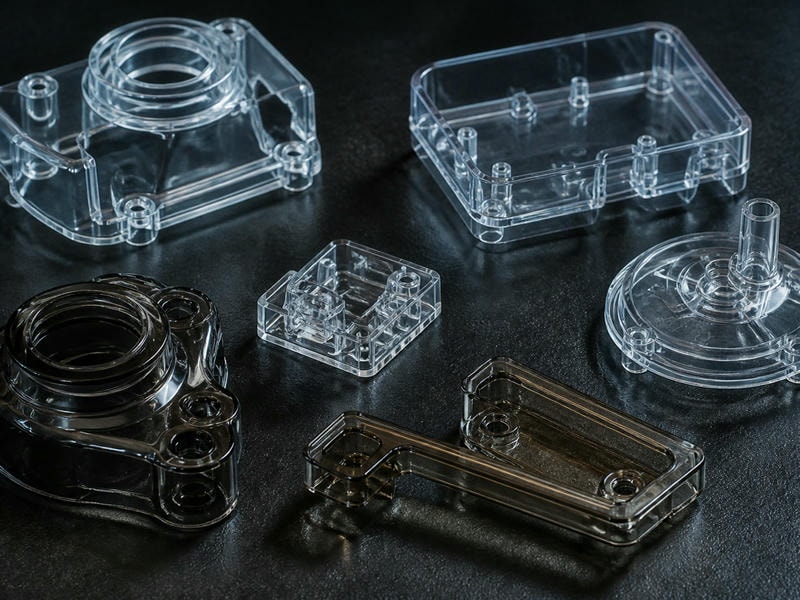
Custom PC Injection Molding Services | High-Strength Polycarbonate Parts
Professional PC injection molding services from Shenzhen. We provide precision molding for high-strength, transparent, and durable polycarbonate components. Request a quote today.
View details →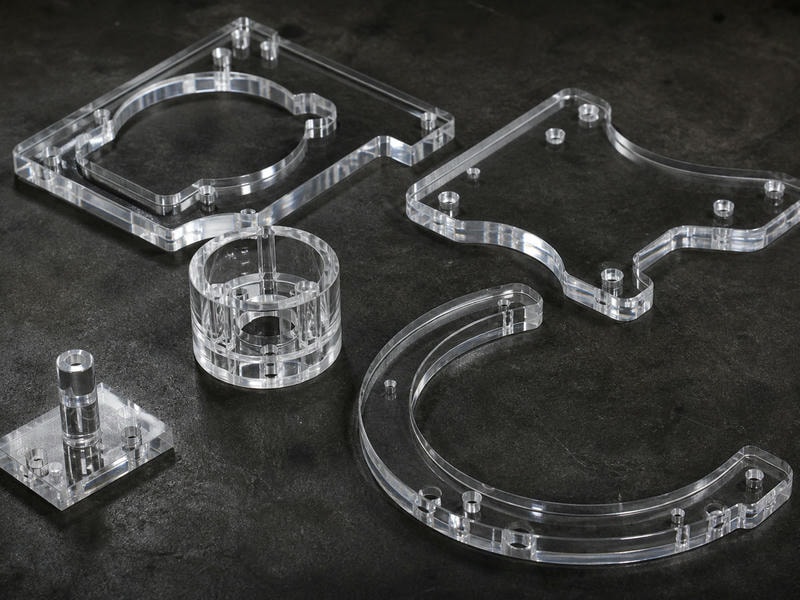
PC CNC Machining Services for Custom Plastic Parts
Custom PC CNC machining for prototypes and production parts. Shenzhen supplier for polycarbonate components from CAD files and drawings.
View details →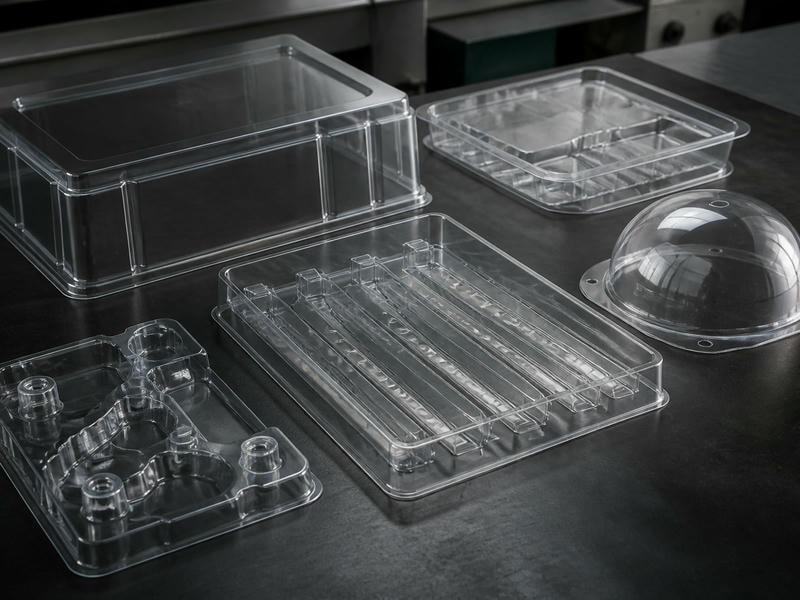
Custom PC Thermoforming & Vacuum Forming Services | Plasticpartsmfg
Professional PC thermoforming and vacuum forming services for custom plastic components. High-precision parts for industrial, automotive, and electronics. Request a quote.
View details →Polycarbonate Grades & Specialty Formulations
We source commercial, engineering, and specialty polycarbonate resins and machinable stock depending on your operating temperature, mechanical load, and optical specifications.
| PC Material Grade | Key Properties | Typical Process | Common Applications |
|---|---|---|---|
| Optical Clear PC (Unfilled) | 89% transmission, high clarity, superior toughness | CNC Machining, Injection Molding | Lenses, sight windows, flow cells, display shields |
| Flame-Retardant PC (UL94 V-0) | Self-extinguishing, electrical resistance, heat stable | Injection Molding, Thermoforming | Power distribution covers, switchgear, EV battery housings |
| Glass-Filled PC (10%-30% GF) | Increased tensile modulus, lower creep, rigid structure | CNC Machining, Injection Molding | Structural brackets, pump bodies, industrial impellers |
| UV-Stabilized Polycarbonate | Resists outdoor yellowing and embrittlement under sunlight | Thermoforming, Extrusion, Molding | Outdoor sensor shells, marine panels, solar equipment |
| PC/ABS Alloy | Balanced impact resistance, improved processability, low shrinkage | Injection Molding, Vacuum Casting | Automotive interior bezels, handheld device housings |
Surface Finishing & Optical Clarity Post-Processing
Polycarbonate is prone to micro-scratches and residual tool marks during subtractive CNC milling. Plasticpartsmfg offers specialized chemical and mechanical finishing lines in Shenzhen to achieve application-ready transparency:
- ✓ Vapor Polishing: Solvents reflow the outer micron layer, eliminating tool marks on internal channels and external surfaces without dimensional degradation.
- ✓ Optical Hand Lapping: Progressive wet sanding up to 2000+ grit followed by compounding for flat inspection windows.
- ✓ Mold Texture Standards: SPI A-1/A-2 mirror polish for clear molded parts; Mold-Tech textures (MT11010, MT11020) for matte cosmetic skins.
- ✓ Anti-Scratch & Anti-Glare Coatings: Dip or spray hard-coating for components subjected to regular wipe-downs and outdoor abrasion.
Polycarbonate Design Considerations
Request a Polycarbonate Part Quotation
Submit your 3D CAD files (STEP, STP, IGES) and 2D engineering drawings with specific tolerances, finishing grades, and quantities. Our engineering team reviews DFM feasibility and provides quotes typically within 24 hours.