
Precision Plastic Micro Injection Molding Services
Plasticpartsmfg manufactures miniature engineered plastic components in Shenzhen, China. From rapid prototype tooling to high-volume multi-cavity production, we deliver micro parts with weights from 0.01g to 10g, thin walls, and tolerances down to ±0.01 mm.
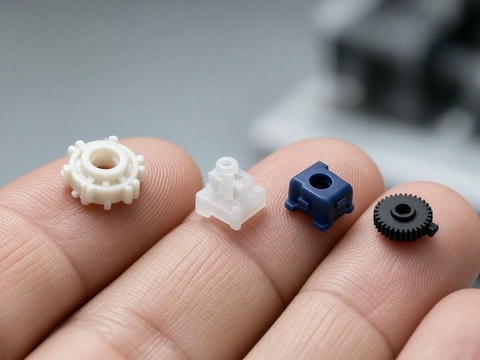
Sub-Gram Precision Molding
Specialized tooling and controlled cavity pressure for medical, electronic, and sensor assemblies.
Technical Capabilities for Miniature Components
Our micro molding infrastructure is purpose-built to control filling, thermal balance, and dimensional repeatability where conventional injection equipment falls short.
| Capability | Typical Specification | Engineering Note |
|---|---|---|
| Part Weight Range | 0.01 g – 10 g | Optimized for fractional-gram and micro-cavity tooling |
| Dimensional Tolerance | ±0.01 mm – ±0.05 mm | Subject to geometry, resin shrinkage, and gate arrangement |
| Supported Materials | POM, PA, PC, PBT, PPS, PEEK, ABS | Unfilled, glass-reinforced, and high-temp formulation support |
| Feature Precision | Fine micro-features, thin walls, micro-ribs | Precision EDM and high-speed CNC tooling resolution |
| Production Scale | Bridge prototype to multi-cavity mass runs | Scalable tooling paths matched to lifecycle volume |
| Secondary Operations | Assembly, optical inspection, custom packaging | ESD protection, clean-room prep, and sub-assembly support |
Controlled Cavity Filling
Precise screw displacement and sensitive barrel heating prevent thermal degradation and eliminate short-shot defects in ultra-small shot sizes.
Strict Tolerance Control
Micron-level tooling tolerances, balanced runner designs, and stabilized cooling circuits maintain critical dimensions across multi-cavity runs.
Scalable Tooling Strategy
Start with single-cavity prototype molds for functional DFM validation, then transfer tooling parameters into production molds without re-engineering.
Specialized Engineering Resins for Micro-Scale Parts
Material selection governs melt flow, mold release, feature fill, and mechanical behavior under operating stress. Explore our common micro-molding polymers below.
Polyoxymethylene (Acetal / POM) & Polyamide (Nylon / PA)
Low Friction & High ToughnessPOM and PA offer excellent lubricity, fatigue strength, and mechanical stiffness. They are ideal for moving parts, sliding mechanisms, and miniature gear trains where dimensional integrity and wear resistance are essential under continuous friction.
Industry Applications & Product Solutions
Engineered for sectors where mechanical failure is not an option and miniature packaging space is tightly constrained.
Electronics & Sensors
Micro-housings, sensor covers, precision terminal blocks, insulator headers, and low-profile board-to-wire connector bodies.
Medical & Diagnostics
Microfluidic channels, fluid check valves, diagnostic cartridge tips, analytical instrument nozzles, and wearable patch clips.
Precision Instruments
Miniature planetary gears, escapement wheels, optical spacers, detent pins, and ultra-fine mechanical linkage arms.
Robotics & Automation
End-effector micro-grippers, miniature servo housing shells, sensor mountings, and high-frequency actuation components.
Metrology, Cleanliness & Quality Control
Sub-gram parts cannot be measured reliably with traditional calipers. Plasticpartsmfg integrates non-contact optical measurement systems, high-magnification profile projectors, and video measuring machines (VMM) to verify micron-level features.
High-resolution VMM scanning ensures zero deformation of sensitive micro-walls during dimensional checks.
Continuous cavity pressure and melt temperature monitoring ensure repeat part weight consistency across full production runs.
FAI (First Article Inspection), CPK capability reports, material certification, and RoHs/REACH compliance documentation.
Secondary Operations & Assembly
Miniature parts require gentle, specialized secondary handling to protect features from mechanical deformation and static buildup:
Micro-pin insertion, ultra-fine snap fitting, ultrasonic welding, and adhesive bonding under magnification.
Custom tape-and-reel, anti-static trays, and compartmented packaging to avoid entanglements and electro-static dust.
Micro-degating methods that prevent gate vestige exceeding drawing allowances on functional sealing surfaces.
De-ionized cleaning to eliminate microscopic debris and particulates prior to final packaging or delivery.
Step-by-Step Project Workflow
From initial 3D model validation to series shipment, our team guides you through each phase of micro-molding production.
CAD Submission
Provide your 3D CAD files (STEP, STP, IGS) alongside engineering drawings specifying critical dimensions, resin grades, and usage volume.
DFM & Gate Strategy
Our engineers conduct a mold flow and micro-DFM study, analyzing parting lines, gate diameter, venting channels, and draft angles.
Tooling & T1 Samples
We fabricate micro-tooling using high-precision CNC and mirror EDM, followed by initial T1 sample runs and complete dimensional reports.
Series Production
Following customer sample validation, we ramp up production to batch volume with in-process optical inspection and verified packaging.
Request a Quotation & DFM Review
Send your drawings and functional specifications to our tooling engineering team. We will review wall thicknesses, gate vestige limitations, and tolerance feasibilities, then provide a detailed quote within 24 business hours.