
High-Precision 3D Printing Prototyping Services
Plasticpartsmfg delivers fast, high-accuracy additive manufacturing for engineers, hardware startups, and product developers. Accelerate functional testing, verify assembly fits, and streamline early iterations directly from your 3D CAD models.
±0.15mm
Typical Accuracy
24-48h
Dispatch Lead Time
FDM / SLA / SLS / MJF
In-House Fleet
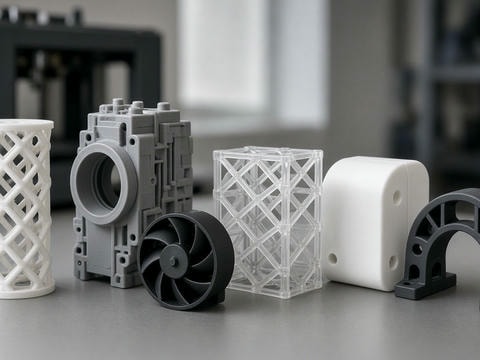
Dimensional verification and surface treatment applied according to engineering drawings and design tolerance specifications.
Technical Capabilities & Processes
Choose from four industrial additive manufacturing technologies balanced for mechanical strength, visual appeal, and turnaround speed.
FDM Printing
Extrudes thermoplastic filaments layer by layer. Excellent for rapid proof-of-concept testing, oversized mockups, manufacturing jigs, and functional brackets where economy and mechanical utility take priority.
Best Applications
Low-cost functional prototypes, shop-floor jigs, tooling fixtures, early assembly checks.
Supported Materials
ABS, PLA, PETG, TPU (various shore hardness levels).
Layer Thickness Range
0.12 mm – 0.30 mm per pass.
Mechanical Nature
Moderate directional strength; strong XY plane resistance.
Material Specifications
Material performance determines whether a prototype survives functional validation. We stock certified engineering polymers tested against thermal deflection, structural impact, and environmental exposure.
Engineering Plastics
Nylon (PA12, PA11), Polycarbonate (PC), ABS, and PETG. Formulated for high tensile resistance, snap-fit mechanics, and thermal stability in electronic environments.
Elastomers & Flexible Materials
Thermoplastic Polyurethane (TPU) available across variable Shore hardness scales (65A to 95A) for seals, gaskets, protective dampeners, and ergonomic grips.
Specialty Resins
Standard, Tough, Rigid Ceramic-reinforced, High-Temperature (HDT over 200°C), and water-clear transparent grades for flow analysis and aesthetic enclosures.
Precision and Tolerances
Additive manufacturing requires disciplined process controls to ensure repeatable dimensional accuracy and trouble-free mechanical fit.
| Parameter | Standard Specification |
|---|---|
| Layer Thickness | 0.025 mm – 0.30 mm (technology dependent) |
| Typical Tolerance | ±0.15 mm – 0.50 mm (geometry and size dependent) |
| Supported File Formats | STEP (.step, .stp), STL, OBJ, 3MF, IGES |
| Max Build Envelope | Up to 800 mm × 800 mm × 600 mm for large-scale automotive structures |
| Minimum Wall Thickness | 0.8 mm (supported) / 1.0 mm (unsupported) |
Quality Inspection Protocols
Critical dimensions are inspected using digital vernier calipers, micrometers, and optical 3D scanners upon request to guarantee compliance prior to international export.
Secondary Operations & In-House Finishing
Transform raw 3D prints into production-equivalent cosmetic displays or field-ready functional assemblies with our post-processing suite.
Surface Finishing
Graded grit manual sanding, automated glass-bead blasting, and optical polishing eliminate layer striations to achieve specified matte or gloss surface profiles.
Painting & Dyeing
Deep bath chemical dyeing for porous Nylon (PA12) alongside automated polyurethane spray painting matched accurately to custom Pantone or RAL color codes.
Hardware & Assembly
Installation of brass heat-set or press-fit threaded inserts (M2–M8), structural bonding with cyanoacrylate/epoxy, and full sub-assembly integration.
Marking & Branding
High-contrast fiber laser engraving and precision multi-color silk screening for permanent logos, part serializations, and user interface symbols.
When to Use 3D Printing Prototyping
3D printing is the fastest path for early-stage verification, but choosing the right manufacturing phase ensures capital efficiency. We guide hardware teams through the full development trajectory.
Next Phase Consulting
Once physical validation is complete, our Shenzhen factory engineers assist in smoothly transitioning your designs to high-speed CNC machining or rapid tooling injection molds.
Early Design Iteration & Ergonomics
Confirm form, hand-feel, snap mechanisms, and internal PCB clearances before committing budget to rigid tooling or extensive CNC setup times.
Functional & Mechanical Stress Testing
Deploy SLS or MJF polyamide parts to test pneumatic seals, mechanical vibration resistance, drop survival, and thermal behavior in real operational settings.
Bridge Production (50 – 200+ Units)
Maintain client deliveries and pilot beta test rollouts while awaiting multi-cavity injection molds. Eliminate production down-time with additive batches.
Seamless CNC & Molding Transition
Gain design feedback for injection draft angles, uniform wall distributions, and machining accessibility directly from our manufacturing engineers.
Serving Diverse Engineering Industries
Tailored additive solutions that satisfy stringent durability, weight, and thermal requirements across technical verticals.
Robotics & Automation
Lightweight end-of-arm tooling, structural robot chassis frames, sensor mounts, and protective motor housings produced in resilient Nylon PA12.
Consumer Electronics
Precision device enclosures, ergonomic wearables, snap-together battery doors, and presentation mockups with painted, market-ready aesthetics.
Medical & Diagnostics
Enclosures for point-of-care laboratory equipment, diagnostic fluid cartridges, ergonomic handheld handles, and non-invasive surgical test fixtures.
Automotive
Dashboard air duct assemblies, custom center console brackets, interior trim fit-checks, and under-hood temperature-resistant test manifolds.
Request an Engineering Quotation
Send your CAD geometry and specifications directly to our engineering desk. You can also contact us via email at .
Checklist for fastest turnaround:
- 1. 3D CAD Files: STEP (.stp), STL, 3MF, or IGES format.
- 2. Material Selection: Preferred polymer or required thermal/mechanical loads.
- 3. Quantity: Prototype test quantities or bridge batch size.
- 4. Finishing Notes: As-printed, bead-blasted, painted (RAL/Pantone), or threaded inserts.
- 5. Required Timeline: Delivery milestone or urgent expedited requirement.